

- 1 1. What Is an MQL5 Multi-Timeframe EA?
- 2 2. Why Multi-Timeframe Analysis Is Needed
- 3 3. How to Implement It in MQL5
- 4 4. Common Mistakes and Precautions
- 5 5. Comparison with Other Methods
- 6 6. Practical Use Cases
- 7 7. Advanced Application Patterns
- 8 8. FAQ
- 8.1 8.1 Is Multi-Timeframe Analysis Required?
- 8.2 8.2 Which Timeframe Combination Is Best?
- 8.3 8.3 Should I Use CopyRates or CopyBuffer?
- 8.4 8.4 How Do You Detect a Closed Bar?
- 8.5 8.5 Can MTF Be Used for Scalping?
- 8.6 8.6 Can Performance Become a Problem?
- 8.7 8.7 Can Backtests Be Trusted?
- 8.8 8.8 How Much Do Spread and Slippage Matter?
- 9 9. Summary
1. What Is an MQL5 Multi-Timeframe EA?
Conclusion:
A multi-timeframe EA is a method that improves accuracy and reproducibility by checking data from multiple timeframes at the same time before making trade decisions.
Its core value is that it separates “market context” from “execution” better than a single-timeframe EA.
1.1 Definition and Basic Concept
Definition:
An MQL5 multi-timeframe EA is an automated trading program that combines different timeframes, such as M5, H1, and D1, to make trading decisions.
A typical EA makes decisions on one timeframe, such as M5 only. With MTF (Multi Timeframe), the roles are separated as follows.
- Higher timeframes, such as H1 and D1: identify the trend and market direction
- Lower timeframes, such as M5 and M15: decide entry timing
The key point is to assign a clear role to each timeframe.
This reduces the risk of relying only on noisy lower-timeframe price action.
1.2 Difference from a Single-Timeframe EA
Conclusion:
A single-timeframe EA is simple but vulnerable to noise. An MTF EA is more complex, but it often provides higher accuracy.
Characteristics of a single-timeframe EA:
- Easy to implement and lightweight
- More trades
- Weak against noise and false signals
Characteristics of a multi-timeframe EA:
- Can enter in the same direction as the higher-timeframe trend
- Can reduce unnecessary trades
- Slightly more complex to implement because data management is required
For example, the structure can look like this.
- Confirm an uptrend on H1
- Detect a pullback on M5
- Enter with OrderSend only when the conditions match
This structure helps reduce mistaken countertrend orders and unnecessary execution.
1.3 What Can It Actually Do?
Conclusion:
MTF makes three things possible: market context analysis, filtering, and more accurate entries.
Main use cases include the following.
- Trend filter
- Use a moving average (MA) on a higher timeframe to determine direction
- Volatility check
- Use ATR or a similar indicator to judge the strength of market movement
- Entry optimization
- Use a lower timeframe to time entries more precisely
Concrete logic example:
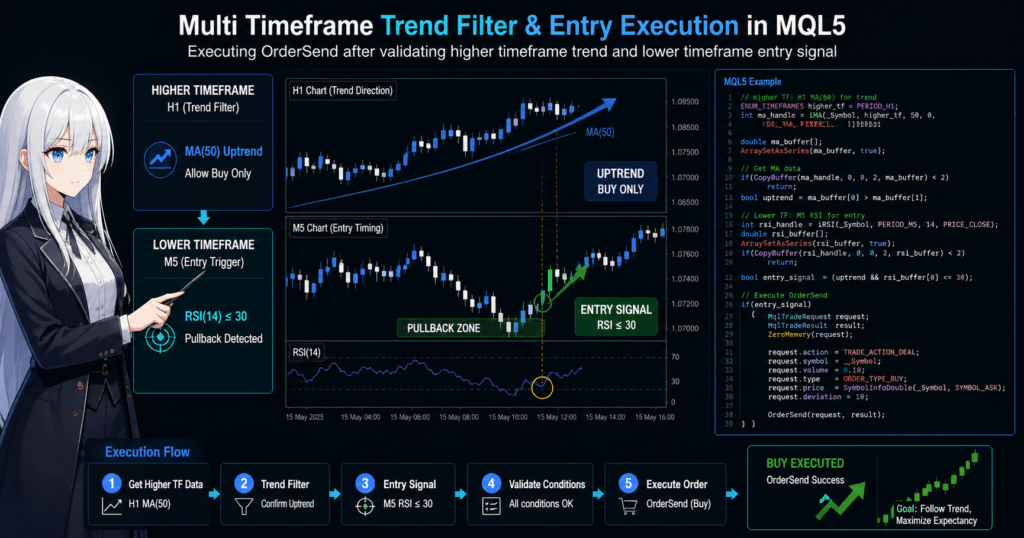
- H1 MA is rising: allow buy trades only
- M5 RSI is 30 or lower: treat it as a pullback
- Conditions are met: execute the order
In this way, the expected value can improve by narrowing the trade conditions.
1.4 Related Keywords and Practical Concepts
Conclusion:
MTF is not just a combination of timeframes. It must be considered together with execution quality and cost factors.
Important practical concepts:
- spread
Wider spreads reduce entry accuracy - slippage
Execution price differences can break the logic - execution
Execution quality depends on the VPS and broker environment - order conditions
These directly affect the reproducibility of the order logic
MTF often means more filters and fewer trades.
Because of that, the quality of each trade, especially execution quality, becomes important.
1.5 Common Beginner Pitfalls
Conclusion:
Even if the MTF concept is simple, the logic can fail quickly when timeframe data is handled incorrectly.
Common mistakes:
- Comparing data from different timeframes directly
- Generating signals from an unclosed bar
- Using CopyBuffer or CopyRates incorrectly
- Ignoring index shifts in arrays
Why this happens:
- In MQL5, each timeframe has its own independent data array
- Without time synchronization, the EA may reference data from different points in time
Basic ways to avoid this:
- Use ArraySetAsSeries to standardize array direction
- Always confirm that a bar has closed
- Understand what the same index means in each context
2. Why Multi-Timeframe Analysis Is Needed
Conclusion:
Multi-timeframe analysis is needed because it can align the trend direction with the entry direction, reduce unnecessary trades, and improve expected value.
A single timeframe cannot avoid both noise and directional mismatch.
2.1 Problems with a Single-Timeframe EA
Conclusion:
A single-timeframe EA is strongly affected by noise, so its structure can easily lead to a lower win rate and larger drawdown.
On lower timeframes such as M1 to M15, the following problems occur.
- More noise, meaning random price movement
- Frequent signals against the main trend
- More stop losses caused by false signals
Example:
- A buy signal appears on M5
- However, H1 is in a downtrend
- Result: price moves against the entry and the trade is stopped out
The root cause is that a single timeframe cannot capture the broader market context.
2.2 Basic Structure of Multi-Timeframe Logic
Conclusion:
MTF is built around role separation: higher timeframe equals market context, and lower timeframe equals execution.
Basic structure:
- Higher timeframe, such as H1 or D1
Determines trend direction and market environment - Lower timeframe, such as M5 or M15
Optimizes entry timing
This structure makes the following possible.
- Execute only trades aligned with the trend
- Avoid unfavorable conditions, such as ranging markets or countertrend entries
- Reduce wasted execution
The important idea is this:
- The higher timeframe is the filter
- The lower timeframe is the trigger
This separation is the essence of MTF.
2.3 Why Expected Value Can Improve
Conclusion:
MTF affects both win-rate improvement and loss reduction, which can improve expected value.
Expected value structure:
- Expected value = win rate x profit – loss rate x loss
Changes caused by MTF:
- Win rate: increases because entries align with the trend
- Loss rate: decreases because countertrend entries are reduced
- Losses: decrease because unnecessary stop losses are reduced
Concrete improvement mechanisms:
- Filtering effect
Removes trades that do not meet the conditions - Higher precision
Improves entry location - Drawdown control
Avoids unfavorable market conditions
As a result, the balance between PF (profit factor) and DD (drawdown) can improve.
2.4 Trade-Off with Trade Frequency
Conclusion:
MTF can improve accuracy, but it also reduces trade frequency. Design balance is therefore important.
Common changes:
- Trade count: decreases
- Accuracy: increases
- Importance of each trade: increases
Important cautions:
- Too many filters can create missed opportunities
- If conditions are too strict, the EA may look good in backtesting but fail in live trading
Design guideline:
- The goal is to remove waste
- The goal is not simply to reduce trades
2.5 Difference from Other Methods
Conclusion:
MTF is a method that improves accuracy structurally. It is different from simply adding more indicators.
Comparison:
- Single timeframe plus more indicators
A symptomatic response to noise - Multi-timeframe structure
A more fundamental improvement that uses market structure
In short, MTF improves the quality of information.
2.6 Practical Importance
Conclusion:
In live trading, MTF works as a mechanism for avoiding unnecessary trades.
Especially important situations:
- During spread widening
- Before and after economic news releases
- During abnormal volatility
Using MTF can help you:
- Prevent forced entries
- Maintain execution quality
- Avoid unnecessary slippage impact
These factors are directly connected to the long-term stability of an EA.
3. How to Implement It in MQL5
Conclusion:
A multi-timeframe EA is implemented with this flow: get higher-timeframe data, identify the trend, evaluate entry conditions on the lower timeframe, and execute the order.
The key points are data retrieval and managing timeframe misalignment.
3.1 Basic Implementation Flow
Conclusion:
The implementation has five steps. Following the order helps preserve reproducibility.
Steps:
- 1. Define the higher timeframe
- 2. Get higher-timeframe data
- 3. Determine the trend direction
- 4. Check entry conditions on the current timeframe
- 5. Execute the order with OrderSend
Code example (basic structure):
// Higher-timeframe setting
ENUM_TIMEFRAMES higher_tf = PERIOD_H1;

// Handle for MA retrieval
int ma_handle = iMA(_Symbol, higher_tf, 50, 0, MODE_SMA, PRICE_CLOSE);

// Buffer retrieval
double ma_buffer[];
CopyBuffer(ma_handle, 0, 0, 2, ma_buffer);

// Trend check
bool uptrend = ma_buffer[0] > ma_buffer[1];

// Entry condition on the current timeframe
if(uptrend)
{
    // Place an order when the buy condition is met
    MqlTradeRequest request;
    MqlTradeResult result;

    ZeroMemory(request);

    request.action = TRADE_ACTION_DEAL;
    request.symbol = _Symbol;
    request.volume = 0.1;
    request.type = ORDER_TYPE_BUY;
    request.price = SymbolInfoDouble(_Symbol, SYMBOL_ASK);

    OrderSend(request, result);
}
Key points:
- Use higher-timeframe information to decide direction
- Use the lower timeframe for timing
- Run OrderSend only when the conditions are met
3.2 How to Get Higher-Timeframe Data
Conclusion:
The data retrieval method differs between price data and indicator data.
Main methods:
1. Price Data (Candlesticks)
MqlRates rates[];
CopyRates(_Symbol, PERIOD_H1, 0, 10, rates);
Use cases:
- Getting highs, lows, and closes
- Candlestick pattern analysis
2. Indicators (MA, RSI, and Similar Values)
int handle = iRSI(_Symbol, PERIOD_H1, 14, PRICE_CLOSE);

double buffer[];
CopyBuffer(handle, 0, 0, 2, buffer);
Use cases:
- Trend judgment
- Oscillator judgment
3. Custom Indicators
int handle = iCustom(_Symbol, PERIOD_H1, "CustomIndicator");
Use case:
- Using custom logic
How to choose:
- Simple logic: CopyRates
- Indicator-based logic: CopyBuffer
- Custom logic: iCustom
3.3 Important Processing to Prevent Timeframe Misalignment
Conclusion:
The most important MTF tasks are time synchronization and standardizing array direction.
Standardizing Array Direction
ArraySetAsSeries(ma_buffer, true);
Reasons:
- To make the latest data index 0
- To keep consistency with other arrays
Checking for a Closed Bar
static datetime last_time = 0;
datetime current_time = iTime(_Symbol, PERIOD_H1, 0);

if(current_time != last_time)
{
    last_time = current_time;
    // New bar confirmed
}
Reasons:
- Prevents misjudgment from an unclosed bar
- Avoids false signals
Checking for Insufficient Data
if(CopyBuffer(handle, 0, 0, 2, buffer) < 2)
{
    return;
}
Reasons:
- Handles insufficient data immediately after initialization
- Avoids errors
3.4 Important Implementation Points
Conclusion:
In MTF implementation, backtesting and live trading can diverge if accuracy and stability are not prioritized.
Important points:
- Be careful with OnTick dependency
Processing does not run unless a tick arrives - Execution timing
Entries should be avoided when spreads widen - Slippage control
Set acceptable slippage - Lot management
Prevent excessive risk
Example (spread check):
double spread = (SymbolInfoDouble(_Symbol, SYMBOL_ASK) -
                 SymbolInfoDouble(_Symbol, SYMBOL_BID)) / _Point;

if(spread > 20)
{
    return; // Avoid entry because the spread is wide
}
3.5 Common Mistakes and Fixes
Conclusion:
Most MTF failures are caused by mistakes in data handling.
Common mistakes:
- Not checking the return value of CopyBuffer
- Comparing data from different timeframes directly
- Using an unclosed bar
- Index misalignment
Fix summary:
- Always confirm that the bar is closed
- Standardize array direction
- Check data retrieval results
- Compare data on the same time basis
3.6 Minimal Setup for Beginners
Conclusion:
At first, you should start with a simple setup: one higher timeframe and one lower timeframe.
Recommended setup:
- H1: trend judgment with MA
- M5: entry with RSI or a similar signal
Reasons:
- Easier debugging
- Clear cause-and-effect in the logic
- Prevents over-optimization
4. Common Mistakes and Precautions
Conclusion:
The most common problems in a multi-timeframe EA are not the trade logic itself. They are timeframe data handling mistakes, incorrect use of unclosed bars, and excessive conditions.
Poor consistency management often causes worse results than implementation difficulty itself.
4.1 Making Decisions with an Unclosed Bar
Conclusion:
If you use an unclosed bar, the signal may look good in backtesting or visual inspection but disappear in live trading.
This mistake is especially common in MTF logic.
For example, when referencing an H1 moving average or RSI before the H1 bar has closed, the value may change on the next tick. A condition that looked valid at entry time may become invalid after the bar closes.
Common failure examples:
- Using higher-timeframe
index 0directly for trade decisions - Evaluating higher-timeframe conditions on every tick without new-bar detection
- Building the logic around interim values that are hard to see in the tester
The countermeasures are clear.
- As a rule, use closed bars for higher-timeframe judgment
- Use
index 1when necessary - Use
iTime()to confirm a new bar before updating the signal
Code example:
datetime current_h1_time = iTime(_Symbol, PERIOD_H1, 0);
static datetime last_h1_time = 0;

if(current_h1_time != last_h1_time)
{
    last_h1_time = current_h1_time;
    // Update the higher-timeframe signal here
}
The reason is that an EA needs reproducibility, and using values that change during a bar reduces verifiability.
4.2 Underestimating Array Index and Timeframe Misalignment
Conclusion:
In MTF, the same index 0 does not always mean the same time.
If you misunderstand this, the EA becomes broken because it compares data from different times.
In MQL5, M5 and H1 are different time series.
Therefore, comparing M5 close[0] with H1 buffer[0] directly does not guarantee that both values represent the same point in time.
Common incorrect implementations:
- Directly comparing the latest lower-timeframe bar with the latest higher-timeframe bar
- Using
CopyRatesorCopyBufferwithout understanding the retrieval order - Forgetting
ArraySetAsSeries(true)
Minimum requirements:
- Standardize array direction
- Separate roles: higher timeframe for direction, lower timeframe for execution
- Use time values to check consistency
Code example:
double ma_buffer[];
ArraySetAsSeries(ma_buffer, true);

if(CopyBuffer(ma_handle, 0, 0, 3, ma_buffer) < 3)
{
    return;
}
Note that ArraySetAsSeries does not automatically solve the meaning gap between timeframes.
It only aligns the array direction. It does not map times for you.
4.3 Adding Too Many Conditions Until the EA Cannot Trade
Conclusion:
MTF is an effective filter, but if you stack too many conditions, it becomes a trade-stopping device rather than an expected-value improvement.
Beginners often follow this pattern.
- MA rising on H1
- MA also rising on H4
- RSI condition on M15
- ATR condition
- spread limit
- slippage limit
- time-of-day filter
- day-of-week filter
This may look clean in theory, but in practice it almost never gets filled.
When the number of trades becomes too small, the statistical reliability of PF and win rate also drops.
The decision criteria are simple.
- Is the purpose of adding the condition clear?
- Can you explain which loss that condition is meant to reduce?
- Did the sample size drop too much after adding it?
As an alternative, it is often more stable to limit the higher timeframe to one role instead of adding more conditions.
For example, H1 only determines the trend, and M5 only handles the entry.
4.4 Ignoring Execution Costs
Conclusion:
Even if MTF improves signal accuracy, live results can break down if spread, slippage, and execution delay are ignored.
This is especially important when entries are made on the lower timeframe.
For example, even if M5 identifies an excellent pullback, a wide spread can make the actual fill price worse than expected. If slippage is also large, the edge shown in testing can disappear.
Minimum items to check:
- Current spread
- Trading session
- Before and after economic news releases
- Broker execution characteristics
Code example:
double ask = SymbolInfoDouble(_Symbol, SYMBOL_ASK);
double bid = SymbolInfoDouble(_Symbol, SYMBOL_BID);
double spread = (ask - bid) / _Point;

if(spread > 20)
{
    return;
}
This is necessary because MTF often reduces trade count, so the impact of worse costs on each trade becomes relatively larger.
4.5 Overtrusting Tester Results
Conclusion:
An MTF EA can look promising in the tester but diverge from live trading because of data synchronization and execution differences.
Pay special attention to:
- Timing of higher-timeframe data references
- Tick generation method
- Fixed-spread testing
- Execution differences between live and demo accounts
A common misunderstanding is that if an EA wins in backtesting, it will also win in live trading.
In reality, the advantage of MTF depends on logic consistency. When the assumptions of the test environment break, results can break as well.
In practice, it is safer to validate in this order.
- Backtest
- Forward test
- Small-lot live trading
This order makes it easier to separate design mistakes from execution risk.
4.6 Beginner Precautions Summary
Conclusion:
Instead of building a complex MTF setup from the start, it is usually more successful to begin with one higher timeframe, one lower timeframe, and one role for each.
Minimal setup guideline:
- Use H1 for direction
- Use M5 for entry
- Add only a spread limit
- Strictly use closed-bar confirmation
This structure makes cause analysis easier and helps identify what to fix after a failure.
MTF is not a technique for adding more features. It is a technique for dividing trading decisions into separate roles.
5. Comparison with Other Methods
Conclusion:
A multi-timeframe EA focuses on accuracy, while a single-timeframe EA focuses on simplicity and speed.
Neither is always better. They should be selected based on the strategy goal and operating style.
5.1 Comparison Table for Decision-Making
Conclusion:
MTF is strong in accuracy and stability, while a single-timeframe EA is strong in trade frequency and ease of implementation.
| Item | Multi-Timeframe EA | Single-Timeframe EA |
|---|---|---|
| Accuracy (win rate) | Tends to be high | Moderate |
| Trade count | Low | High |
| Drawdown (DD) | Easier to control | Can become larger |
| Implementation difficulty | High because data management is required | Low |
| Reproducibility | High because conditions are clear | Somewhat unstable |
| Execution dependency | High | Moderate |
| Impact of spread and slippage | Large because there are fewer trades | More easily distributed |
Important points:
- MTF is a design for removing unnecessary trades
- A single-timeframe EA is a design that tries to capture more opportunities through frequency
5.2 Essential Difference from a Single-Timeframe EA
Conclusion:
The difference is not the amount of information. It is the quality of information.
Single-timeframe EA:
- Makes decisions using only information from the same timeframe
- Must handle noise directly
- Often compensates by adding indicators
MTF EA:
- Combines information from different timeframes
- Filters noise with the higher timeframe
- Optimizes execution with the lower timeframe
In short, MTF is a structure-based design.
Unlike adding more indicators, it uses the hierarchical structure of the market across timeframes.
5.3 Which One Should You Choose?
Conclusion:
Beginners should usually start with a single timeframe, while intermediate and advanced users are better suited for MTF.
Decision criteria:
When a Single-Timeframe EA Is Suitable
- Early stage of EA development
- When validating the core logic is the priority
- When easy debugging matters
When a Multi-Timeframe EA Is Suitable
- Trend-following strategies
- When you want to reduce unnecessary trades
- When you want to control DD
- When long-term operation is assumed
Important idea:
- You do not need to start with MTF
- Single timeframe, problem analysis, then MTF improvement
This order is more reproducible.
5.4 Comparison with Other Alternatives
Conclusion:
MTF improves filter quality, so its role differs from other filter-based methods.
Common alternatives:
Indicator-Stacking Method
- Combines several indicators such as MA, RSI, and MACD
- Problem: the noise itself does not decrease
Volatility Filter
- Uses ATR to avoid low-volatility conditions
- Problem: it cannot determine direction
Time-of-Day Filter
- Trades only during London or New York sessions
- Problem: it does not consider market direction
Advantages of MTF:
- Can directly handle trend direction
- Can avoid the source of noise itself
- Can be combined with other filters
In other words, MTF is a higher-level concept. It does not replace other filters; it is a foundation that can be combined with them.
5.5 Best Practical Combination
Conclusion:
MTF becomes more stable when combined with a minimal set of filters instead of being used alone.
Recommended setup:
- Higher timeframe: trend judgment with MA
- Lower timeframe: entry with RSI or a similar signal
- Support filters:
- spread limit
- ATR filter to avoid abnormal values
- time-of-day limit
The important point is not to overdo it.
- Keep conditions to about 3 to 5
- Use only conditions with a clear purpose
5.6 Important Design Perspective
Conclusion:
MTF is not a technique for increasing win rate by itself. It is a technique for reducing losing trades.
This perspective makes the design more stable.
- Which losing trades do you want to reduce?
- Which market conditions do you want to avoid?
- How should the higher timeframe be used for that purpose?
Thinking in this order helps prevent unnecessary condition stacking.
6. Practical Use Cases
Conclusion:
A multi-timeframe EA is strong at improving accuracy in trending markets and avoiding unnecessary trades, especially in strategies designed for long-term operation.
However, it is not suitable for every market or every strategy.
6.1 Effective Cases
Conclusion:
MTF works well in markets with clear direction and in strategies where filtering is important.
Common effective cases:
Trend-Following Strategy
- Use the higher timeframe to determine trend direction
- Use the lower timeframe to target pullbacks or retracements
- Remove unnecessary countertrend entries
Example:
- H1 is in an uptrend
- M5 has a temporary drop
- RSI drops: buy the pullback
Combination with a Volatility Filter
- Use ATR or a similar indicator to judge the strength of market movement
- Avoid inactive low-volatility markets
Benefits:
- Reduces unnecessary range trades
- Avoids losing to spread costs
Avoiding Abnormal Conditions (Risk Management)
- Avoid sharp moves and unstable markets
- Stop trading before and after economic news releases
In practice, this is used as follows:
- Higher timeframe is unstable: stop trading
- ATR rises sharply: avoid trading
- spread is abnormal: stop execution
6.2 Cases Where MTF Is Not Suitable
Conclusion:
MTF is not suitable for high-speed, high-frequency, or ultra-short-term strategies.
Common examples:
Scalping
- Trades held for seconds to a few minutes
- Execution speed is the top priority
Problems:
- Higher-timeframe judgment is slow
- Signal frequency decreases
- Slippage has a large impact
High-Frequency Trading Style Strategies
- Tick-level decisions
- Latency can be fatal
MTF is structurally disadvantaged here.
Range-Only Strategies
- Markets that move back and forth within a range
- A trend filter can sometimes work against the strategy
In this case:
- Higher-timeframe trend judgment may not work
- The filter may remove valid opportunities
6.3 Design Points for Live Operation
Conclusion:
MTF requires not only correct logic but also optimization of the execution environment.
Important points:
VPS Operation (Almost Required)
- Reduces latency
- Prevents execution delay
Reasons:
- MTF has fewer entries
- One delay can directly affect performance
Broker Characteristics
- Execution speed
- Spread fluctuation
- Slippage tendency
The same EA can produce different results, so this must be considered.
Spread and Cost Management
double spread = (SymbolInfoDouble(_Symbol, SYMBOL_ASK) -
                 SymbolInfoDouble(_Symbol, SYMBOL_BID)) / _Point;

if(spread > 20)
{
    return;
}
Key points:
- Avoid times when spread is wide
- Prevent cost deterioration
Trading Session Control
- Limit trading to London and New York sessions
- Avoid low-liquidity periods
Reasons:
- Reduced slippage risk
- More stable execution
6.4 Practical Design Pattern Focused on Reproducibility
Conclusion:
For MTF, maintaining a simple structure is directly connected to long-term stability.
Recommended pattern:
- Higher timeframe: trend judgment with MA
- Lower timeframe: entry with RSI
- Filters:
- spread limit
- time-of-day limit
Designs to avoid:
- Too many layered conditions
- Too many indicators
- Over-optimization
Reasons:
- The logic becomes a black box
- It tends to fail in forward testing
6.5 Relationship with Risk Management
Conclusion:
MTF reaches its full value only when combined with risk management.
Important elements:
- Lot management (position sizing)
- DD control (drawdown management)
- Stopping after consecutive losses
MTF alone only reduces some losing trades.
Stable operation becomes possible only when it is combined with money management.
6.6 Practical Decision Criteria Summary
Conclusion:
MTF is powerful when used in the right situation, but it is not a universal solution.
Decision criteria:
- Target trending markets: suitable
- Prioritize trade count: not suitable
- Long-term stable operation: suitable
- Ultra-short-term trading: not suitable
7. Advanced Application Patterns
Conclusion:
A multi-timeframe EA can improve accuracy and flexibility by adding timeframes, expanding symbols, and integrating indicators.
However, expansion leads directly to over-optimization unless the purpose is limited.
7.1 Triple-Timeframe Structure
Conclusion:
Using three timeframes lets you divide roles into broad context, medium-term direction, and short-term execution, which strengthens decision consistency.
Basic structure:
- D1: long-term trend and market environment
- H1: medium-term trend and direction confirmation
- M5: entry and execution
Logic example:
- D1 is in an uptrend
- H1 also continues upward
- A pullback appears on M5: enter
Code image (simplified):
bool trend_d1 = CheckTrend(PERIOD_D1);
bool trend_h1 = CheckTrend(PERIOD_H1);

if(trend_d1 && trend_h1)
{
    if(CheckEntrySignal(PERIOD_M5))
    {
        ExecuteOrder();
    }
}
Benefits:
- Improved resistance to false signals
- Better trend consistency
Cautions:
- Filters can easily become excessive
- Trade count may drop sharply
7.2 Multi-Symbol Integration
Conclusion:
Combining multiple currency pairs enables more advanced decisions based on correlation.
Common examples:
- Confirming directional agreement between EURUSD and USDJPY
- Using gold (XAUUSD) to identify risk-off conditions
Logic example:
- EURUSD is rising
- USDJPY is falling
USD is weak, so buying EURUSD may have an advantage
Code image:
double eurusd_price = SymbolInfoDouble("EURUSD", SYMBOL_BID);
double usdjpy_price = SymbolInfoDouble("USDJPY", SYMBOL_BID);
Benefits:
- Can judge broader market strength and weakness
- Reduces false signals
Cautions:
- Higher load on the execution environment
- Higher data retrieval cost
7.3 Indicator Combination (MTF x Indicators)
Conclusion:
Combining MTF with indicators can further improve trend and timing accuracy.
Common combinations:
- MA for trend plus RSI for pullbacks
- MA plus ATR for volatility
- RSI plus MACD for momentum
Logic example:
- H1 MA is rising: trend judgment
- M5 RSI is 30 or lower: pullback
- ATR is above a certain level: allow trading
Code example:
int rsi_handle = iRSI(_Symbol, PERIOD_M5, 14, PRICE_CLOSE);

double rsi[];
CopyBuffer(rsi_handle, 0, 0, 1, rsi);

if(rsi[0] < 30)
{
    // Pullback condition
}
Important points:
- Give each indicator a separate role
- Do not duplicate indicators that measure the same thing
7.4 State Management with a State Machine
Conclusion:
Managing the EA by state makes complex MTF logic less likely to break.
Example states:
- WAIT
- TREND_DETECTED
- ENTRY_READY
- POSITION_OPEN
Benefits:
- Separation of logic
- Easier debugging
- Better reproducibility
Code image:
enum State
{
    WAIT,
    TREND,
    ENTRY
};

State current_state = WAIT;
Why it works:
- MTF tends to accumulate conditions
- State management clarifies what should happen and when
7.5 Performance Optimization
Conclusion:
MTF increases calculation cost, so without optimization it can create VPS load and delays.
Countermeasures:
- Run CopyBuffer only when needed
- Calculate only on a new bar
- Reduce unnecessary symbol references
Example:
if(IsNewBar(PERIOD_H1))
{
    UpdateHigherTimeframe();
}
Benefits:
- Lower CPU load
- More stable execution
7.6 Design That Prevents Over-Optimization
Conclusion:
Advanced patterns are powerful, but they must be used only within a range where verifiability and reproducibility can be maintained.
Risky patterns:
- Adding too many timeframes
- Adjusting conditions too finely
- Optimizing only for a specific period
Safer design:
- Give every element a clear role
- Check what improved each time you add something
- Validate with forward testing
7.7 Moving from Beginner to Intermediate Level
Conclusion:
Advanced MTF should be expanded step by step to avoid breaking the logic.
Recommended steps:
- Create a single-timeframe EA
- Add a higher-timeframe filter
- Validate each condition one by one
- Add another timeframe only if needed
This flow lets the EA grow while keeping the relationship between cause and result clear.
8. FAQ
Conclusion:
A multi-timeframe EA can be operated more consistently if you understand data handling and design intent.
The following questions summarize the most common implementation and operation issues.
8.1 Is Multi-Timeframe Analysis Required?
Conclusion:
No, it is not required, but it is very effective as a trend filter.
You can build an EA with a single timeframe.
However, entries against the trend become more common, so MTF can help reduce unnecessary trades.
8.2 Which Timeframe Combination Is Best?
Conclusion:
The basic structure is one higher timeframe plus one lower timeframe. H1 plus M5 is a common combination.
Selection guideline:
- Swing-oriented: H4 plus M15
- Day trading: H1 plus M5
- Short-term trading: M15 plus M1
The important point is to consider the timeframe ratio, roughly 3 to 6 times.
8.3 Should I Use CopyRates or CopyBuffer?
Conclusion:
Use CopyRates for price data and CopyBuffer for indicator values.
How to separate them:
- CopyRates: candlestick data such as open, high, low, and close
- CopyBuffer: indicator values such as MA and RSI
Confusing them can break the logic.
8.4 How Do You Detect a Closed Bar?
Conclusion:
The simplest and safest method is to use changes in iTime().
Reasons:
- It can detect the moment a new bar is generated
- It helps prevent incorrect use of unclosed bars
Important points:
- Use higher-timeframe data only after the bar has closed
- Unclosed data reduces reproducibility
8.5 Can MTF Be Used for Scalping?
Conclusion:
In general, it is not suitable.
Reasons:
- Higher-timeframe judgment can create delay
- Execution speed has the highest priority
- Slippage has a larger impact
MTF focuses on accuracy, so it does not pair well with speed-first strategies.
8.6 Can Performance Become a Problem?
Conclusion:
It is usually not a problem if implemented properly, but optimization is necessary.
Countermeasures:
- Calculate only on a new bar
- Reduce unnecessary CopyBuffer calls
- Minimize symbol references
These steps allow stable operation even on a VPS.
8.7 Can Backtests Be Trusted?
Conclusion:
They are useful as a reference, but they cannot be trusted completely.
Reasons:
- Data synchronization gaps
- Fixed-spread assumptions
- Execution differences from live trading
In practice, validation should follow this order:
- Backtest
- Forward test
- Small-lot live trading
8.8 How Much Do Spread and Slippage Matter?
Conclusion:
Because MTF often produces fewer trades, the impact of each spread or slippage event becomes larger.
Concrete impacts:
- spread widening: lower entry accuracy
- slippage: deviation from the intended logic
Countermeasures:
- Add a spread limit
- Trade only during high-liquidity sessions
- Choose an environment with strong execution performance
9. Summary
Conclusion:
A multi-timeframe EA is a method that uses higher timeframes for market context and lower timeframes for entries, reducing unnecessary trades and improving expected value.
Its essence is not increasing the amount of information. It is improving the quality of information.
9.1 Key Points from This Article
Conclusion:
The core of MTF is role separation and consistency management.
Important points:
- Higher timeframe: direction and trend judgment
- Lower timeframe: timing and execution
- Filters reduce unnecessary entries
Implementation essentials:
- Correct separation of CopyBuffer and CopyRates
- Strict closed-bar confirmation, without using unclosed data
- Management of array index and timeframe misalignment
9.2 Successful Design Pattern
Conclusion:
Keeping the structure simple is the most reproducible design.
Recommended setup:
- H1: trend judgment with MA or a similar indicator
- M5: entry with RSI or a similar signal
- Support:
- spread limit
- time-of-day filter
Designs to avoid:
- Too many layered conditions
- Too many indicators
- Over-optimization
Reasons:
- The cause-and-effect relationship in the logic becomes unclear
- It tends to fail in forward testing
9.3 Practical Usage Guidelines
Conclusion:
MTF should not be treated as a technique for guaranteed wins. It should be used as a structure for reducing losing trades.
Decision criteria:
- Target trending markets: suitable
- Reduce unnecessary trades: suitable
- Increase trade count: not suitable
- Ultra-short-term strategies: not suitable
Stability improves when MTF is combined with the following elements.
- Lot management (position sizing)
- DD control (drawdown management)
- Execution environment optimization, including VPS and broker selection
9.4 Fastest Path to a Practical-Level MTF EA
Conclusion:
You can build an MTF EA that does not break by constructing it step by step.
Recommended steps:
- Create a single-timeframe EA
- Add a higher-timeframe filter
- Confirm closed bars and data consistency
- Validate with forward testing
- Expand only when needed
Following this order creates an EA that is verifiable and highly reproducible.
9.5 Final Practical Note
Conclusion:
MTF is powerful, but its value comes from simple design and accurate implementation.
- More conditions do not automatically make the EA better
- Design must include execution costs such as spread and slippage
- Always be aware of the gap between testing and live operation
If these points are handled properly, MTF can become a foundation for a long-term, stable trading strategy.