

- 1 1. What Is Equity Protection in MQL5?
- 2 2. How to Implement Equity Protection in MQL5
- 3 3. How Equity Protection Works and the Core of Risk Management
- 4 4. Comparison With Other Risk Management Methods
- 5 5. Common Failures and Important Notes
- 5.1 5.1 Threshold Setting Mistakes
- 5.2 5.2 Mistakes With Initial Equity and Reference Values
- 5.3 5.3 Faulty Close-All Processing
- 5.4 5.4 Failure to Stop New Orders
- 5.5 5.5 Execution Timing Problems: OnTick Dependency
- 5.6 5.6 False Triggers From Spread and Market Conditions
- 5.7 5.7 Mismatch With Lot Size
- 5.8 5.8 Interference With Multiple EAs and Manual Trading
- 5.9 5.9 Why These Problems Happen
- 6 6. Practical Use Cases by Strategy
- 7 7. Advanced Equity Protection Design
- 8 8. FAQ
- 8.1 8.1 What Is the Difference Between Equity Protection and Stop Loss?
- 8.2 8.2 What Percentage Should Equity Protection Use?
- 8.3 8.3 Should Every EA Use Equity Protection?
- 8.4 8.4 Does Equity Protection Help Maximize Profit?
- 8.5 8.5 Is Backtesting Enough?
- 8.6 8.6 Can Equity Protection Be Shared Across Multiple EAs?
- 8.7 8.7 What Should I Watch for on a VPS?
- 8.8 8.8 Is Equity Protection Alone Enough for Safe Operation?
1. What Is Equity Protection in MQL5?
Conclusion: Equity Protection is a mechanism that automatically controls trading when account Equity falls below a defined level, helping prevent losses from expanding across the entire account.
Conclusion: It is the final defense line against account failure risk that individual Stop Loss settings cannot fully prevent.
1.1 Definition
Conclusion: Equity Protection is a risk management method that uses account Equity, including unrealized profit and loss, as the trigger for forced position closure or suspension of new orders.
Definition:
- Equity: Real-time account value, including current balance and floating profit or loss
- Balance: Account value that reflects only realized profit and loss
The important point is to monitor Equity, not Balance.
Balance does not reflect floating losses, so it can hide a dangerous account condition. Equity, on the other hand, reflects the current risk more accurately.
1.2 Key Related Terms
Conclusion: To understand Equity Protection, you need at least the basic concepts related to margin and account risk.
- Equity: Current practical account value, including floating profit and loss
- Balance: Realized account value
- Margin: Funds required to maintain open positions
- Free Margin: Funds available for additional orders
- Drawdown: Maximum decline in account value
For example, when floating losses increase, Balance stays the same but Equity drops sharply. This gap can become the trigger for account failure.
1.3 Why Beginners Need It More
Conclusion: Beginners often tend to leave floating losses open, so without Equity Protection, account capital can collapse quickly.
Common failure patterns include:
- Averaging down by adding to losing positions
- Increasing positions through grid strategies
- Holding positions without evidence because “price will come back”
- Trading without a Stop Loss
These approaches may produce short-term gains, but if the market moves in one direction, they create a structure where the account can fail in a single event.
Equity Protection helps with this problem by:
- Forcing a stop at a defined level
- Limiting the damage
- Leaving enough capital to recover
That is its role.
1.4 Why Individual Stop Losses Are Not Enough
Conclusion: A Stop Loss works at the individual trade level, while Equity Protection works at the account level. Their roles are different.
Limits of Stop Loss:
- Weak when multiple positions lose at the same time
- Hard to use effectively with averaging-down or grid strategies
- Can still produce unexpected losses due to slippage or execution delays
Equity Protection, by contrast:
- Manages all positions together
- Acts as a final defense during abnormal conditions such as sudden volatility or spread widening
- Controls risk at the account level
Therefore, in real trading systems,
using Stop Loss and Equity Protection together is the basic structure.
2. How to Implement Equity Protection in MQL5
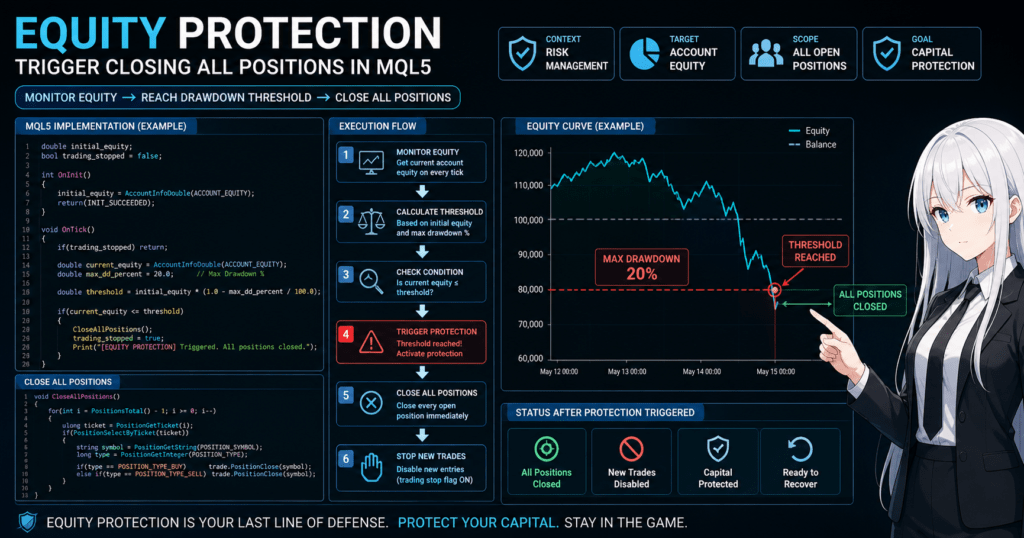
Conclusion: Equity Protection can be implemented in three steps: monitor Equity, compare it with a threshold, then close all positions and stop new orders when the condition is met.
Conclusion: In real operation, false-trigger prevention for spread, slippage, and execution issues, plus flags that prevent re-entry, are essential.
2.1 Basic Implementation Logic
Conclusion: The logic is simple, but the trigger condition and execution process must be designed carefully.
Basic flow:
- Get the current Equity
- Decide the reference value, such as initial capital or maximum Equity
- Set the acceptable drawdown percentage
- Trigger when Equity falls below the threshold
- Close all positions
- Stop new orders
Key points:
- Use real-time Equity
- Managing drawdown by percentage is more flexible
- Preventing re-entry after activation is mandatory
2.2 Implementation Steps You Can Use As-Is
Conclusion: If you implement the following steps as-is, a minimum Equity Protection function will work.
Steps
- 1. Record the initial Equity, usually in OnInit
- 2. Get the current Equity on every tick
- 3. Set the acceptable drawdown percentage, for example 20%
- 4. Calculate the threshold
- 5. Check the condition
- 6. Close all positions
- 7. Turn on the flag that stops new orders
Code Example: Minimal Version
double initial_equity;
bool trading_stopped = false;

int OnInit()
{
    initial_equity = AccountInfoDouble(ACCOUNT_EQUITY);
    return(INIT_SUCCEEDED);
}

void OnTick()
{
    if(trading_stopped) return;

    double current_equity = AccountInfoDouble(ACCOUNT_EQUITY);
    double max_dd_percent = 20.0;

    double threshold = initial_equity * (1.0 - max_dd_percent / 100.0);

    if(current_equity <= threshold)
    {
        CloseAllPositions();
        trading_stopped = true;
    }
}
Close-All Processing
void CloseAllPositions()
{
    for(int i = PositionsTotal() - 1; i >= 0; i--)
    {
        ulong ticket = PositionGetTicket(i);
        if(PositionSelectByTicket(ticket))
        {
            string symbol = PositionGetString(POSITION_SYMBOL);
            long type = PositionGetInteger(POSITION_TYPE);

            if(type == POSITION_TYPE_BUY)
                trade.PositionClose(symbol);
            else if(type == POSITION_TYPE_SELL)
                trade.PositionClose(symbol);
        }
    }
}
2.3 Additional Logic Needed in Real Trading
Conclusion: The code above is not enough for live use, so at minimum you should add the following safeguards.
1. Prevent False Triggers During Abnormal Spread
- A sudden spread expansion can trigger the protection incorrectly
- Countermeasure: add a spread filter
double spread = SymbolInfoDouble(_Symbol, SYMBOL_ASK) - SymbolInfoDouble(_Symbol, SYMBOL_BID);
if(spread > MaxSpread) return;
2. Handle Slippage and Execution Problems
- Execution delays may prevent positions from closing as intended
- Countermeasure: use retry logic or check OrderSendResult
3. Handle trade context busy
- This can occur with multiple EAs or high-speed processing
- Countermeasure: use Sleep plus retry logic
4. Consider the VPS Environment
- Network latency can shift the activation timing
- Be especially careful around economic news releases
2.4 Common Implementation Failures
Conclusion: The three common failures of Equity Protection are that it does not trigger, triggers too late, or triggers unexpectedly.
Failure 1: Incorrect Handling of Initial Equity
- The value resets after restarting the EA
→ Save it to a file or use GlobalVariable
Failure 2: Some Positions Are Not Closed
- The loop is implemented incorrectly
→ A reverse loop is required
Failure 3: New Orders Are Not Stopped
- The EA re-enters after closing positions
→ Flag management is required
Failure 4: Mismatch With Lot Size
- A very large lot causes a one-shot drawdown
→ Use it together with lot size control
2.5 Why This Structure Is Needed
Conclusion: Equity Protection is the last safety device. When it activates, the account is already in an abnormal condition, so reliability has the highest priority.
- Normal trading logic maximizes profit
- Equity Protection minimizes loss
- The roles are completely different
Therefore:
- Keep the design simple
- Make sure it runs reliably
- Add strong exception handling
This is the foundation of practical design.
3. How Equity Protection Works and the Core of Risk Management
Conclusion: Equity Protection monitors the current account risk, including floating loss, in real time and forces losses to be realized before the account reaches a failure level.
Conclusion: It is not a profit-increasing function. It is the final defense line for protecting capital and preserving the chance to recover.
3.1 Why Manage Risk Based on Equity?
Conclusion: Equity reflects profit and loss at the current moment, so it detects risk the fastest.
- Balance reflects only realized profit and loss → it ignores floating losses
- Equity includes floating profit and loss → it accurately reflects current danger
Example:
- Balance: $10,000
- Floating loss: -$3,000
- Equity: $7,000
In this case, the account may look safe if you only check Balance, but it is already in a dangerous zone.
Therefore, Equity-based management is required to avoid account failure.
3.2 Relationship With Drawdown
Conclusion: Equity Protection is a mechanism that forcibly limits maximum drawdown, or Max DD.
Drawdown means:
- The maximum decline from the peak account value
- A measure of the durability of a trading strategy
The role of Equity Protection:
- Stop trading before DD exceeds a defined line
- Help prevent account failure, stop-out, or forced liquidation
- Prevent the equity curve from collapsing
Important point:
- Once DD becomes deep, recovery becomes difficult
- Example: after -50%, a +100% gain is needed to return to the original level
Therefore,
not allowing deep DD is itself part of the strategy.
3.3 Relationship With Trading Strategy
Conclusion: The importance of Equity Protection changes greatly depending on the strategy type.
Countertrend and Averaging-Down Strategies
- They aim for profit while accepting floating loss
- They are weak against one-directional trends
→ Equity Protection is almost mandatory
Grid Strategies
- They are structured to keep increasing positions
- Margin pressure increases → forced stop-out risk rises
→ Equity Protection is critical
Trend Following
- Loss cutting is usually clear
- Floating losses are relatively small
→ Not mandatory, but useful as insurance
Scalping
- Holding time is short
- Execution and slippage have a large impact
→ The effect may be limited
In short,
the more a strategy extends losses, the more important Equity Protection becomes.
3.4 Why It Can Help Prevent Account Failure
Conclusion: Account failure occurs when losses accelerate, so stopping before that acceleration can reduce the risk.
Typical failure structure:
- Floating loss increases
- Margin becomes pressured
- Forced stop-out is triggered
- Losses are realized in a chain reaction
Equity Protection interrupts this flow:
- At stage 2
- Under your own rules
In other words:
- Broker-driven stop-out → executed under the worst conditions
- Your own Equity Protection → exits while the account still has some room
This difference can greatly change long-term survival.
3.5 Limits and Misunderstandings
Conclusion: Equity Protection is not a perfect solution. It is only one method of loss control.
Common misunderstandings:
- It makes the strategy profitable → wrong
- It removes DD → wrong
- It increases profit → not directly
In practice:
- It also cuts off profit opportunities
- Early stopping may reduce expectancy
- Overly strict settings can backfire
The key understanding:
- It is not a feature for winning
- It is a feature for staying alive
4. Comparison With Other Risk Management Methods
Conclusion: Equity Protection is the final defense for the entire account, while other methods manage risk at the individual or pre-entry level. Their roles are different.
Conclusion: It works practically only when combined with Stop Loss, lot control, trailing stops, and other safeguards.
4.1 Comparison Targets
Conclusion: Major risk management methods can be classified by scope and activation timing.
- Equity Protection: entire account, post-loss control
- Stop Loss: individual position, set before or at entry
- Trailing Stop: individual position, profit protection
- Lot Size control: before entry, fixed risk
- Drawdown control: entire account, threshold-based management
Additional note:
- Execution delay and slippage must be considered with every method
- Behavior changes when spread widens
4.2 Method-by-Method Comparison
Conclusion: The selection criterion is which stage of risk you want to control.
| Method | Target | Activation Timing | Coverage | Reproducibility | Feature |
|---|---|---|---|---|---|
| Equity Protection | Entire account | After losses expand | All positions | High | Final defense line |
| Stop Loss | Individual | At entry | Single position | High | Basic risk management |
| Trailing Stop | Individual | After profit appears | Single position | Medium | Profit protection |
| Lot Size control | Before entry | Before trading | Indirect | High | Fixed loss amount |
| Drawdown control | Entire account | After losses expand | Entire account | High | Similar to Equity Protection |
Important points:
- Stop Loss is local optimization
- Equity Protection is whole-account optimization
- Lot control limits risk before entry
4.3 Why Equity Protection Is Needed
Conclusion: Other methods cannot fully prevent simultaneous risk events or strategy-structure risk.
Typical examples:
- Multiple currency pairs move against the account at the same time
- Grid positions keep increasing
- News releases create sudden volatility, execution delay, and slippage
In these cases:
- Stop Loss → works individually, but total loss may still grow
- Trailing Stop → works only after profit exists
- Lot control → cannot stop runaway risk after entry
Therefore,
a final mechanism that stops the whole account is needed.
4.4 Practical Use by Method
Conclusion: The following combination has the highest practical reproducibility.
Basic Structure: Recommended
- Lot Size control, fixing risk per trade
- Stop Loss, controlling individual losses
- Equity Protection, acting as the final defense
Advanced Structure
- Trailing Stop, protecting profit
- Time filter, controlling trading sessions
- Spread filter, avoiding abnormal conditions
This structure allows:
- Three-layer risk control: pre-entry, individual, and whole account
- Removal of a single point of failure
4.5 Common Incorrect Uses
Conclusion: Depending only on Equity Protection can actually increase risk.
Mistake 1: No Stop Loss
- Everything is left to Equity Protection
→ DD becomes too deep
Mistake 2: Excessive Lot Size
- Lot control is ignored
→ The threshold is hit in one move
Mistake 3: Extreme Threshold
- Too strict → stopped by noise
- Too loose → account fails before activation
Mistake 4: Mismatch With Strategy
- Too much restriction on a trend strategy
→ profit opportunities are lost
4.6 Why Combined Risk Management Is Necessary
Conclusion: Market risk does not come from one cause, so one method cannot cover it all.
Types of risk:
- Price movement risk
- Execution risk, including delays
- Slippage
- Spread widening
- System delay from VPS or network conditions
Because these can occur at the same time:
- One method cannot prevent everything
- Layered defense is required
5. Common Failures and Important Notes
Conclusion: Equity Protection often fails in three areas: settings, implementation, and operation. If these are wrong, it may fail to trigger, trigger incorrectly, or stop trading too often.
Conclusion: Threshold settings, execution timing, and reliable close-all processing are especially important in real operation.
5.1 Threshold Setting Mistakes
Conclusion: Depending on the threshold, or drawdown percentage, Equity Protection may either fail to work or stop trading too often.
Typical Examples
- Too strict, for example 5%
- Stops immediately on a small floating loss
- Makes trading impossible because of noise
- Too loose, for example 50%
- The account is effectively broken before activation
Practical Guidelines
- Trend strategies: 10% to 20%
- Grid and averaging-down strategies: 20% to 30%, depending on the strategy
Reason:
- A fixed value is risky because the right level depends on volatility, ATR, and currency-pair characteristics
- Optimization through backtesting and forward testing is required
5.2 Mistakes With Initial Equity and Reference Values
Conclusion: If the reference Equity is wrong, Equity Protection can trigger incorrectly or fail to trigger.
Common Mistakes
- Initial Equity resets after the EA restarts
- Deposits or withdrawals shift the reference value
- Multiple EAs use separate reference values
Countermeasures
- Persist the value with GlobalVariable or a file
- Use maximum Equity, or the peak value, as the reference
- Manage risk at the portfolio level
5.3 Faulty Close-All Processing
Conclusion: Faulty close logic can leave positions open.
Typical Problems
- Wrong loop direction, such as processing forward
- Failure to check PositionSelect errors
- Only some positions are closed
Countermeasures
- Use a reverse loop, which is required
- Add error checks
- Run a confirmation loop after closing positions
Additional Note
- Execution delay and slippage may prevent all positions from closing in one attempt
- Adding retry logic improves safety
5.4 Failure to Stop New Orders
Conclusion: Accidental re-entry after closing positions is very common.
Causes
- No flag management
- Normal logic continues in OnTick
Countermeasures
- Stop completely using a global flag
- Check the flag before every order function
if(trading_stopped) return;
Practical Point
- Output the stopped state to logs so it is visible
- Consider restoration after VPS restart
5.5 Execution Timing Problems: OnTick Dependency
Conclusion: If control depends only on OnTick, activation may be delayed.
The Core Problem
- The condition is not checked unless a tick arrives
- The protection may be too late during sudden volatility
Countermeasures
- Use OnTimer together with OnTick, from milliseconds to seconds
- Use symbols with frequent ticks
- Run the EA in a stable VPS environment
5.6 False Triggers From Spread and Market Conditions
Conclusion: Spread widening or a market closed condition can cause unexpected behavior.
Typical Examples
- Spread expands sharply during news releases → false trigger
- Liquidity drops → execution failure, such as off quotes
Countermeasures
- Add a spread filter
- Check market conditions, trading hours, and liquidity
5.7 Mismatch With Lot Size
Conclusion: Without lot size control, the account can fail before Equity Protection works.
Problem
- Oversized lots → the threshold is reached in one move
- Risk is excessive before expectancy can matter
Countermeasures
- Use fixed risk, such as 1% to 2% per trade
- Check margin with OrderCalcMargin
5.8 Interference With Multiple EAs and Manual Trading
Conclusion: Because Equity Protection works at the account level, it can conflict with other EAs and discretionary trades.
Typical Problems
- Another EA re-enters after the stop
- Manual trades are also affected
Countermeasures
- Separate logic by MagicNumber
- Design the system around whole-account control
- Integrate it into portfolio management
5.9 Why These Problems Happen
Conclusion: Equity Protection is logic that runs during abnormal conditions, so it needs stricter design than normal trading logic.
- Normal conditions → profit optimization
- Abnormal conditions → immediate stop
This gap causes:
- Missing implementation details
- Insufficient testing
- Unexpected market conditions
Therefore:
- Always test abnormal cases such as sudden volatility and spread expansion
- Verify behavior through forward testing
6. Practical Use Cases by Strategy
Conclusion: Equity Protection is not mandatory for every strategy, but it becomes almost mandatory for designs that hold floating losses.
Conclusion: Implementation priority changes based on strategy traits such as holding time, stop-loss structure, and whether positions increase over time.
6.1 Mandatory Cases: High Failure Risk Without It
Conclusion: Strategies that increase positions or extend losses have difficulty surviving long term without Equity Protection.
Grid EAs
- They add positions at fixed intervals
- Floating losses can increase exponentially when a trend appears
- Margin pressure → typical forced stop-out pattern
Key point:
- Estimate the worst case using maximum positions × lot size × volatility, such as ATR
- Fix the exit line using Equity Protection
Averaging-Down Strategies
- They add to losing positions to lower the average entry price
- If price does not return, losses keep expanding
Warning:
- Assuming price will eventually return is a cause of account failure
- Define the maximum loss with Equity Protection
High-Frequency and Multi-Currency Operation
- Multiple symbols can move against the account at the same time
- Correlation can cause simultaneous DD
Countermeasures:
- Set a whole-account DD limit based on Equity
- Control risk at the portfolio level
6.2 Recommended Cases: Improves Stability
Conclusion: It may not be mandatory, but adding it improves resistance to unexpected risk.
Manual Trading Plus EA Trading
- Manual entries are mixed with automated entries
- Rules may be broken by human decision-making
Effect:
- Covers human error
- Automatically clears unexpected positions
Swing to Day Trading
- Holding time is moderate
- News releases and weekend gap risk matter
Additional note:
- Spread widening and slippage are likely to occur
- Equity Protection can limit weekend risk
Multiple-EA Portfolio
- EAs can interfere with each other through simultaneous losses
- Individual optimization does not always produce account-level optimization
Countermeasures:
- Manage whole-account risk in an integrated way
- Individual EA Stop Loss settings are not enough
6.3 Cases Where It Is Unnecessary or Limited
Conclusion: If a strategy already has strict risk control, Equity Protection has lower priority.
Strict Stop-Loss Strategies: Trend Following
- Loss is fixed for each trade
- The number of positions is also limited
Result:
- Whole-account DD is naturally controlled
- Equity Protection is closer to insurance
Ultra-Short-Term Scalping
- Holding time is extremely short
- Trades complete at the tick level
Limitations:
- Execution delay and slippage have a large impact
- Equity checks may not be fast enough
6.4 Practical Design Patterns
Conclusion: Practicality improves when activation conditions and stop scope are adjusted by strategy type.
Pattern 1: Fixed Drawdown Model
- Stop at -20% from initial Equity
- Simple and highly reproducible
Pattern 2: Trailing Equity Model
- Judge DD from maximum Equity
- Useful for protecting accumulated profit
Example:
- After reaching +30%, stop at -10%
Pattern 3: Combined With Time Filters
- Stop around news releases
- Avoid false triggers during abnormal spread
Pattern 4: Symbol-Separated Model
- Manage risk by currency pair
- Separate EURUSD and USDJPY
6.5 Checklist Before Implementation
Conclusion: If the following items are not satisfied, Equity Protection may not work as expected.
- Is lot size appropriate and not too large?
- Is Stop Loss set?
- Is the maximum number of positions controlled?
- Is the VPS environment stable?
- Are execution errors, such as off quotes, handled?
6.6 Why It Depends on Strategy
Conclusion: Equity Protection is a tool that compensates for a strategy’s weaknesses, so the need changes with the strategy structure.
- Strategies that realize losses early → lower need
- Strategies that extend losses → higher need
Therefore:
- First understand the risk structure of the strategy
- Then design Equity Protection
This order matters.
7. Advanced Equity Protection Design
Conclusion: In real operation, stability improves greatly when you combine fixed thresholds with maximum Equity, time, symbols, and market conditions.
Conclusion: The goal is to avoid both stopping too early and stopping too late, reducing account-failure risk without unnecessarily lowering expectancy.
7.1 Trailing Equity: Peak-Based DD
Conclusion: Judging drawdown from maximum Equity, or peak Equity, can protect profit and control risk at the same time.
Concept
- Record the highest reached Equity
- Stop based on the decline from that peak
- As profit grows, the system protects gains instead of allowing the loss limit to expand freely
Steps
- 1. Update max_equity
- 2. Calculate the gap from current Equity
- 3. Stop when the threshold is exceeded
double max_equity = 0.0;
bool trading_stopped = false;

void UpdateMaxEquity()
{
    double eq = AccountInfoDouble(ACCOUNT_EQUITY);
    if(eq > max_equity) max_equity = eq;
}

void CheckTrailingDD()
{
    if(trading_stopped) return;

    double eq = AccountInfoDouble(ACCOUNT_EQUITY);
    double dd_limit = 10.0; // 10%

    double dd = (max_equity - eq) / max_equity * 100.0;

    if(dd >= dd_limit)
    {
        CloseAllPositions();
        trading_stopped = true;
    }
}
Important Notes
- Set max_equity at initialization, such as in OnInit
- Restore it after restart, for example with GlobalVariable
- False triggers can happen from noise right after a sharp rise
7.2 Time Filters and Event-Based Control
Conclusion: Linking protection to economic events or market hours can help avoid false triggers caused by spread widening and slippage.
Use Cases
- Around economic news releases, where volatility and execution instability are high
- Rollover time, when spreads often widen
- Just before market close
Implementation Examples
- Skip checks during specific time windows
- Or temporarily loosen the threshold
bool IsHighRiskTime()
{
    int hour = TimeHour(TimeCurrent());
    return (hour == 23); // Example: rollover
}

void SafeCheck()
{
    if(IsHighRiskTime()) return;
    CheckTrailingDD();
}
Reason
- Equity can temporarily worsen when spread expands sharply
- The filter helps prevent stops caused by noise rather than real risk
7.3 Symbol-Level and Portfolio-Level Management
Conclusion: Separating control by currency pair or EA can prevent a local abnormal condition from stopping the entire account.
Patterns
- Symbol-level DD management
- MagicNumber-level management
- Portfolio-level management
Examples
- Only EURUSD is abnormal → USDJPY continues
- Only a specific EA is stopped
double GetSymbolEquity(string symbol)
{
    double profit = 0;
    for(int i=0;i<PositionsTotal();i++)
    {
        ulong ticket = PositionGetTicket(i);
        if(PositionSelectByTicket(ticket))
        {
            if(PositionGetString(POSITION_SYMBOL) == symbol)
                profit += PositionGetDouble(POSITION_PROFIT);
        }
    }
    return AccountInfoDouble(ACCOUNT_BALANCE) + profit;
}
Important Notes
- Complete separation is difficult because margin is shared
- Correlation must be considered
7.4 Staged Stops: Soft to Hard
Conclusion: Staged control can reduce the drop in expectancy compared with stopping everything at once.
Staged Design
- DD 10%: stop new entries
- DD 15%: reduce lot size by half
- DD 20%: close all positions
if(dd >= 10 && dd < 15) disable_new_entry = true;
if(dd >= 15 && dd < 20) reduce_lot = true;
if(dd >= 20) CloseAllPositions();
Benefits
- Risk is reduced early
- Profit opportunities are not completely removed
Drawbacks
- The logic becomes more complex
- Testing becomes harder
7.5 Design Points for Live Operation
Conclusion: In live operation, reliability and recoverability should have the highest priority.
Required Elements
- State persistence with GlobalVariable or a file
- Log output showing activation reason and time
- Retry logic for execution failures
Environment-Dependent Risks
- VPS latency
- Network disconnection
- Broker rules, including execution rules and slippage behavior
Testing Procedure
- Backtest to verify the logic
- Forward test to verify behavior in a real environment
- Abnormal-condition tests, including sudden volatility and spread expansion
7.6 Why This Much Design Is Necessary
Conclusion: Equity Protection runs only during abnormal conditions, not normal conditions, so it requires even more design precision than normal trading logic.
- Normal: profit optimization
- Abnormal: immediate stop
This gap means:
- Insufficient testing is likely
- Bugs appear under unexpected conditions
Therefore, the design needs:
- A simple core logic plus surrounding safeguards
- Layered filters
- Reproducible behavior
8. FAQ
Conclusion: Equity Protection is specialized for controlling whole-account loss, so it is important to understand its use cases, settings, and relationship with other methods.
8.1 What Is the Difference Between Equity Protection and Stop Loss?
Conclusion: Stop Loss targets individual positions, while Equity Protection targets the entire account.
A Stop Loss is a local loss-cut rule set at entry and cannot control the combined loss of multiple positions. Equity Protection covers all positions and forces a stop when total loss reaches a defined level.
8.2 What Percentage Should Equity Protection Use?
Conclusion: A common range is 10% to 30%, but the right value depends on the strategy and volatility.
For trend following, 10% to 20% is a common guide. For averaging-down or grid systems, 20% to 30% is often used. However, ATR, currency-pair traits, and lot size change the optimal value, so backtesting and forward testing are required.
8.3 Should Every EA Use Equity Protection?
Conclusion: It is essential for averaging-down and grid strategies, and optional but recommended for other strategies.
Strategies built around floating losses have a higher failure probability without it. Strategies with strict Stop Loss rules may not require it, but it is useful insurance against unexpected markets, sudden volatility, and spread expansion.
8.4 Does Equity Protection Help Maximize Profit?
Conclusion: Not directly. Its purpose is loss control.
Equity Protection is not a feature for winning more. It is a feature for avoiding excessive losses. Early stopping can miss profit opportunities, but it can improve capital survival over the long term.
8.5 Is Backtesting Enough?
Conclusion: No. Forward testing is required.
Backtesting does not accurately reproduce execution delays, slippage, or spread expansion. Behavior during sudden volatility should be checked in a forward environment, such as demo trading or a small live account.
8.6 Can Equity Protection Be Shared Across Multiple EAs?
Conclusion: Yes, but conflict control is required.
Because it targets the whole account, it can affect other EAs and manual trades. Without MagicNumber separation or portfolio-level design, unintended stops or re-entries can occur.
8.7 What Should I Watch for on a VPS?
Conclusion: Delay and disconnection can shift the activation timing.
Execution speed depends on VPS quality and distance to the broker server. During news releases, slippage and off quotes are more likely, so retry logic and log monitoring are important.
8.8 Is Equity Protection Alone Enough for Safe Operation?
Conclusion: No. It must be used with other risk controls.
Equity Protection works practically only when combined with lot size control, Stop Loss, spread filters, and maximum position limits. By itself, it covers only part of the risk.